Vision & philosophy
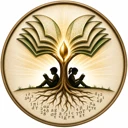
Earth School is Rubania's central educational model — both a philosophy and a physical institution, grounded in Integral Pedagogy and built as the heart of every Ruban Cell.
"School is a place where self-esteem, skill, creativity, and a diversity of perspectives are built — within a natural environment rich in textures, materials, and spaces. A school whose graduates emerge as integral beings, full of curiosity, initiative, will, and the courage to innovate and learn from their mistakes."
A place where youth and adults collaborate not only to learn and create, but also to produce goods and services that add value to the local economy — building healthy bonds and strengthening self-esteem. Learning is driven by voluntary desire and interest, never by obligation; professionals with real skills instruct and facilitate; and the tedium of repetitive tasks is handed to automation so the human factor can adapt and grow freely.
"No one is a slave to any role."
"We used to live in castles surrounded by misery and poverty. Cities with their suburban sprawl and the poor countryside are the modern form of the same pattern."
Earth School addresses this by fusing urban and rural into the RUBAN pattern. The school works toward finding an optimal interface with the earth — ensuring enduring fertility while adhering to patterns that produce resilient and regenerative architecture.
Precedent
Green School Bali is the primary real-world inspiration — proof that a school built from bamboo, open to the jungle, and centred on student agency can produce confident, environmentally literate young people. Earth School borrows its natural-material architecture, wall-less classrooms, student-driven learning and deep integration with nature — then takes the model further by embedding it into an entire settlement.
| Green School Bali | Earth School |
|---|---|
| Isolated campus; families commute or relocate | Embedded in the Ruban Cell — students live in the settlement |
| Education-focused | Produces real economic value: food, construction, energy management |
| K–12 age range | All ages — lifelong learning from childhood through elderhood |
| Student governance is pedagogical | Students take part in real governance via Cell OS: argument maps, deliberation, progressive voting rights |
| Career paths are external | The Guild system provides apprenticeship tracks into productive roles within the cell |
| One campus, one location | The school is the settlement's axis — every Ruban Cell replicates the pattern |
The graduate
Not just someone who knows a lot. Someone who wants to know more — and knows how to find what they need. A being who:
Analyze, contextualize, ask difficult questions.
With their hands, with tools, with materials.
Find their own modes of expression and problem-solving.
For the land, for others, for themselves.
Try, revise, try again without paralysis.
To a place, a community, the natural world.
 Earth School